
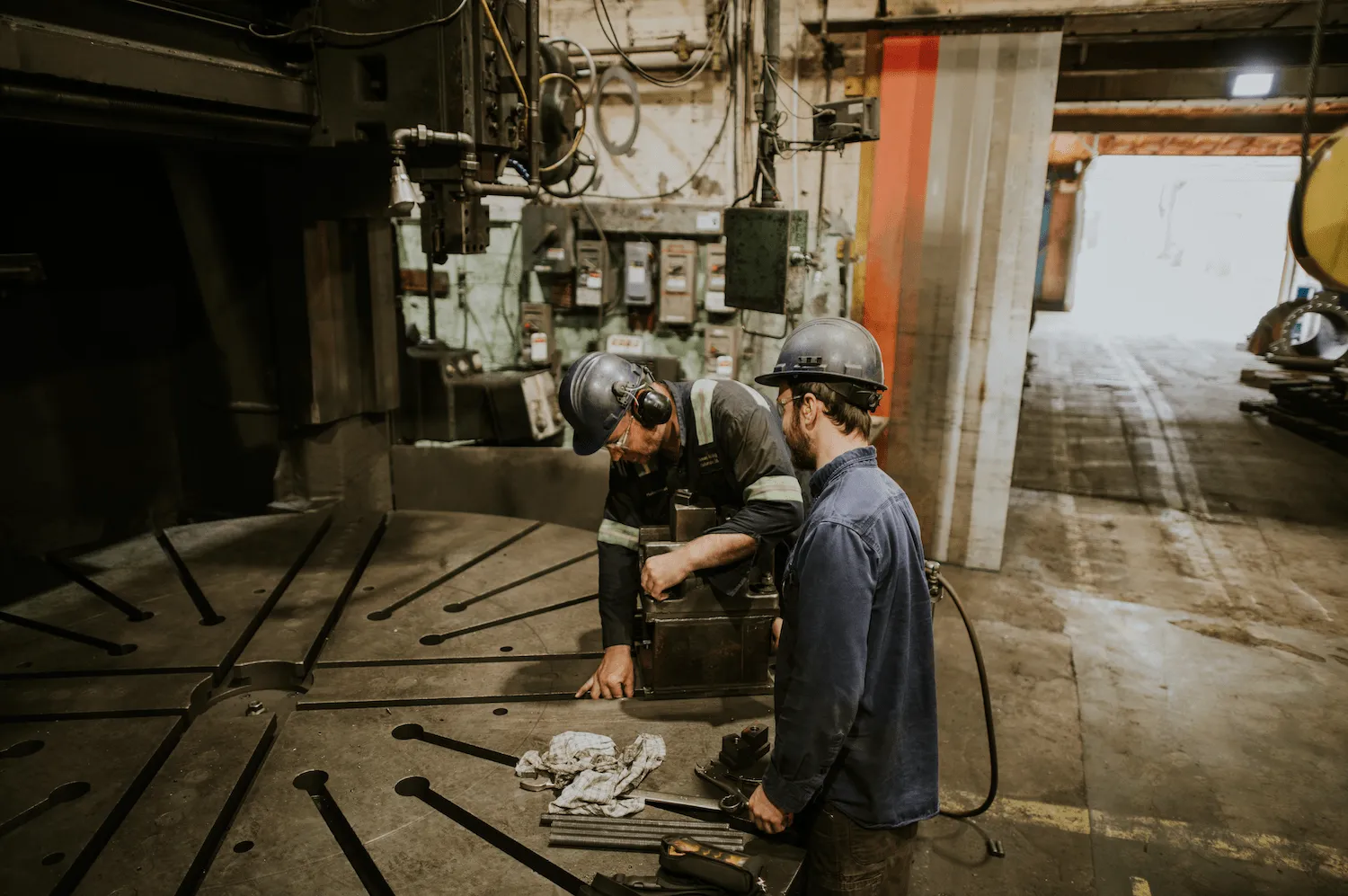
Wabi Iron & Steel Corp. operates an integrated casting foundry and machine shop in New Liskeard, Ontario. We produce heavy-duty custom metal castings ranging from 50 to 8,000 lbs, serving industrial operations where component failure is not an option. From alloy development and casting geometry design through to prototyping, casting, and finishing — our engineering team manages the entire process under one roof.
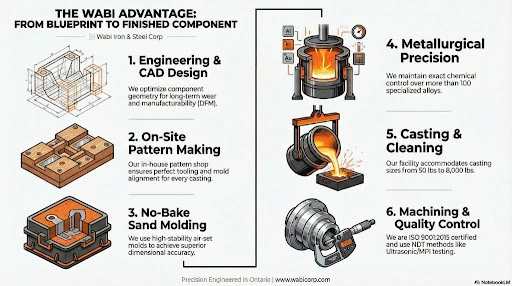
Finding a foundry that controls the full casting lifecycle is rare. Most operations rely on outside pattern shops, contract machine shops, or third-party heat treatment — introducing risk at every handoff. At Wabi, the entire process runs in-house, from the first CAD drawing to the finished, assembly-ready component.
Our engineers work directly with customers to develop casting geometry optimized for manufacturability and long-term wear performance. We can reverse-engineer existing components and produce full drawings and specifications.
On-site pattern-making ensures precise tooling and mold alignment for every casting. Patterns are maintained and stored for repeat orders, reducing lead time on reorders.
Our electric induction furnaces provide precise temperature and chemistry control across 100+ alloys. Induction melting produces consistent, clean metal with low inclusion levels — critical for wear-critical applications.
Components leave our facility machined, finished, and ready to install. Our machine shop handles turning, milling, drilling, and grinding to tight tolerances — no outside processing required.
Our metallurgical laboratory develops and qualifies alloys for specific wear environments. We work across 100+ ferrous and non-ferrous grades, and our proprietary MET500 alloy is available exclusively through Wabi.

Our primary casting method is no-bake sand moulding, which uses chemically bonded sand to produce dimensionally stable, high-integrity moulds. This process is well-suited to the large, complex geometries typical of industrial wear components — accommodating casting weights from 50 to 8,000 lbs across ferrous and non-ferrous alloys.
Our in-house metallurgical laboratory develops and qualifies alloys for specific wear environments rather than defaulting to standard grades. We work across the full spectrum of ferrous alloys: grey iron, ductile iron, white iron (Ni-Hard 1, Ni-Hard 4, high chrome), carbon steel, low alloy steel, and corrosion and heat-resistant stainless steels. All alloys are qualified against ASTM standards.
Our proprietary MET500 alloy was developed specifically for high-impact, high-abrasion applications where standard grades underperform. It is available exclusively through Wabi.
Our castings are operating in some of the most demanding industrial environments in the world. From underground mining to gold refining, we engineer components for operations where downtime is measured in lost production — not inconvenience.
SAG mill liners, crusher wear parts, chute liners, and ore handling components engineered for high-abrasion, high-impact underground and surface mining operations.
Custom wear programs for equipment lifecycle management. We develop alloy-specific solutions that maximize component life and minimize unplanned shutdowns.
Volute housings, impellers, suction liners, and diffusers for centrifugal pump OEMs. Cast in grey iron, white iron, and stainless steel — machined and heat-treated in-house.
Custom and OEM lining systems for SAG, ball, and rod mills. High-chrome irons, nickel-irons, and steels with full heat-treatment control for maximum toughness and hardness.
Coking components, blast furnace parts, and hot metal handling equipment. Our steel-making range includes charging lids, tuyere bodies, ladle hooks, pig iron moulds, and continuous caster fixtures.
Specialized castings for gold refinery operations, including high-temperature and corrosion-resistant alloys suited to the demanding conditions of precious metal processing.
Our castings operate in some of the most demanding industrial environments in the world. From underground mining to gold refining, we engineer components for operations where downtime is measured in lost production — not inconvenience.
Our castings operate in some of the most demanding industrial environments in the world. From underground mining to gold refining, we engineer components for operations where downtime is measured in lost production — not inconvenience.
SAG mill liners, crusher wear parts, chute liners, and ore handling components engineered for high-abrasion, high-impact underground and surface mining operations.
Custom wear programs for equipment lifecycle management. We develop alloy-specific solutions that maximize component life and minimize unplanned shutdowns.
Volute housings, impellers, suction liners, and diffusers for centrifugal pump OEMs. Cast in grey iron, white iron, and stainless steel — machined and heat-treated in-house.
All engineering and manufacturing processes at our foundry are registered under ISO 9001:2015. This means every casting that leaves our facility has been produced, inspected, and documented against a rigorously maintained quality management system.
We perform non-destructive testing (NDT) including magnetic particle inspection and ultrasonic testing on critical components. This allows us to detect subsurface discontinuities without compromising the integrity of the casting — ensuring what ships is what was specified.
Wabi operates with a long-term view of our environmental footprint. Our electric induction furnaces eliminate the combustion emissions associated with fuel-fired melting. Sand reclamation systems reduce waste and minimize raw material consumption. And our focus on producing longer-lasting components means fewer replacements, less material consumption, and reduced downtime across our customers' operations.
All engineering and manufacturing processes at our foundry are registered under ISO 9001:2015. This means every casting that leaves our facility has been produced, inspected, and documented against a rigorously maintained quality management system.
We perform non-destructive testing (NDT) including magnetic particle inspection and ultrasonic testing on critical components. This allows us to detect subsurface discontinuities without compromising the integrity of the casting — ensuring what ships is what was specified.